Ever wished you could build an app without touching a single line of code? Google’s new experiment, Opal, might be your wish come true. Born from Google Labs, Opal is a no-code AI app builder designed to make creating AI-powered tools as easy as sketching an idea on a napkin. But does it truly deliver on that promise—or is it another mirage in the innovation desert?
From No-Code to “Vibe-Coding”
The rise of low-code and AI tools set the stage for Opal—Google’s bid to merge the two worlds. Launched in mid-2025, Opal began as a closed beta in the U.S. and quickly expanded worldwide by November.
At its heart is “vibe-coding”—building apps using natural language and visual prompts instead of code. You describe what you want, and Opal turns your words into a working mini-app. It’s intuitive, conversational, and surprisingly powerful.
What Opal Can Do
Opal lets you:
- Create no-code AI mini-apps from plain English descriptions.
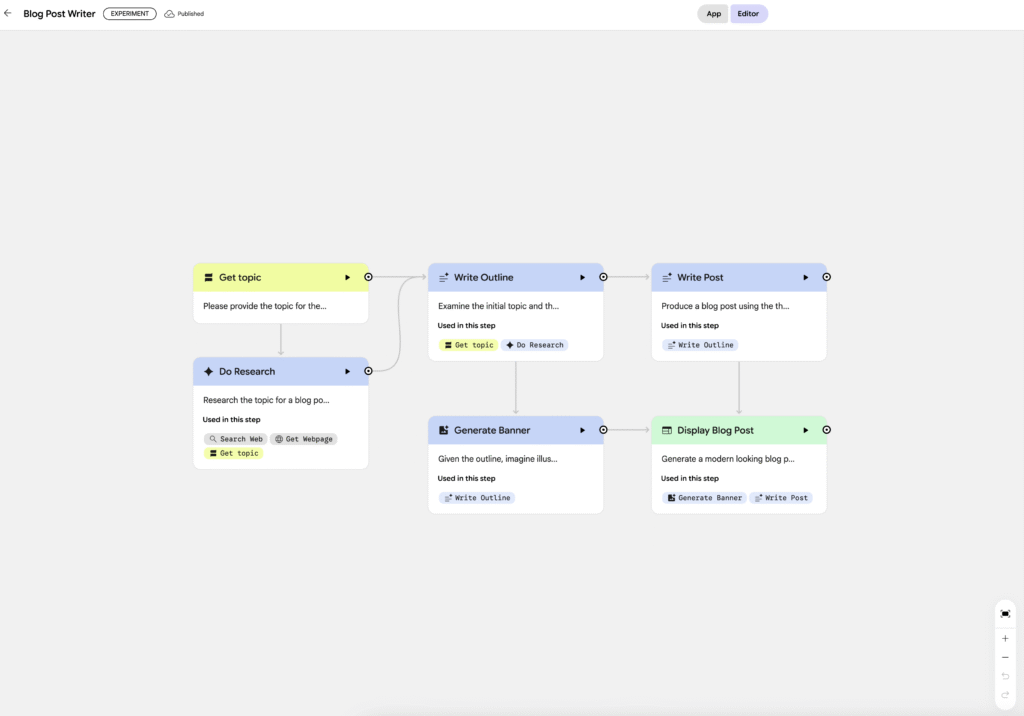
- Build workflows by chaining prompts, AI models, and tools.
- Edit visually or with natural language.
- Leverage Google’s AI suite—Gemini (text), Imagen (images), Veo (video).
- Share instantly with anyone who has a Google account.
- Start fast with templates and starter packs.
Use cases range from rapid prototyping to content generation, learning tools, and automation experiments.
The Buzz—and the Bumps
Why people love it:
- Empowers non-technical creators.
- Enables rapid idea-to-app prototyping.
- Integrates seamlessly with Google’s ecosystem.
- Makes AI development feel fun and accessible.
Where it struggles:
- Limited integrations and no code export.
- Confined to Google’s ecosystem (vendor lock-in).
- Inconsistent AI outputs and opaque debugging.
- Raises privacy and data transparency questions.
- Faces the usual “Google Labs risk” of eventual discontinuation.
What’s Next for Opal
Expect tighter integration with Workspace (Gmail, Drive, Calendar), smarter layouts, richer design control, and a possible marketplace for sharing or selling Opal apps. Google also hints at “agent-style” AIs that can take on tasks more autonomously.
Should You Try It?
Opal shines as a creative playground for rapid prototyping, internal tools, and AI exploration. It’s perfect for curious tinkerers and early adopters—but developers needing deep integrations or code ownership may want to wait.
Still, Opal’s potential is undeniable. It could redefine what “building” means in the age of AI—or fade as another ambitious Google experiment. Either way, it’s worth watching.
Be First to Comment